
Record each void
Write down the time of every urination, day and night.
Urine osmolality profiling for the bladder diary
Osmurix is developing a handheld, home-use urine osmometer that adds objective osmolality profiling to the bladder diary—giving clinicians supplemental data on day-time and night-time urine concentration.
The diagnostic bottleneck
Today, patients are typically asked to complete a frequency–volume chart for three days. The method is clinically useful, but manual recording creates friction and can leave clinicians with an incomplete picture.
Write down the time of every urination, day and night.
Collect and manually record the amount of urine passed.
Track fluid type, timing and volume across the same period.
Volume alone cannot reveal what is driving the excess urine.
“The diary tells us how much. We still need to know why.”
A growing burden
Clinically significant nocturia—two or more night-time voids—affects both men and women, with prevalence approaching one in two among adults over 65.2
Adults reporting ≥2 night-time voids
Bridging the etiological gap
Urine is a solution composed of water and dissolved particles. Osmolality measures the concentration of those particles, adding physiological context to urine volume across the day and night.
Typically <300 mOsm/kg H₂O
Dilute urine can indicate excess free-water excretion or reduced concentrating activity. Any clinical or treatment implications of this pattern are for the treating clinician to determine.
Typically >300 mOsm/kg H₂O
More concentrated urine suggests that dissolved solutes contribute to urine production. This can prompt investigation of sodium, urea, glucose and underlying conditions.
Important: The 300 mOsm/kg H₂O boundary is a clinical heuristic, not a standalone diagnosis or treatment decision. Osmolality must be interpreted with urine volume, timing, medical history and other clinical data.
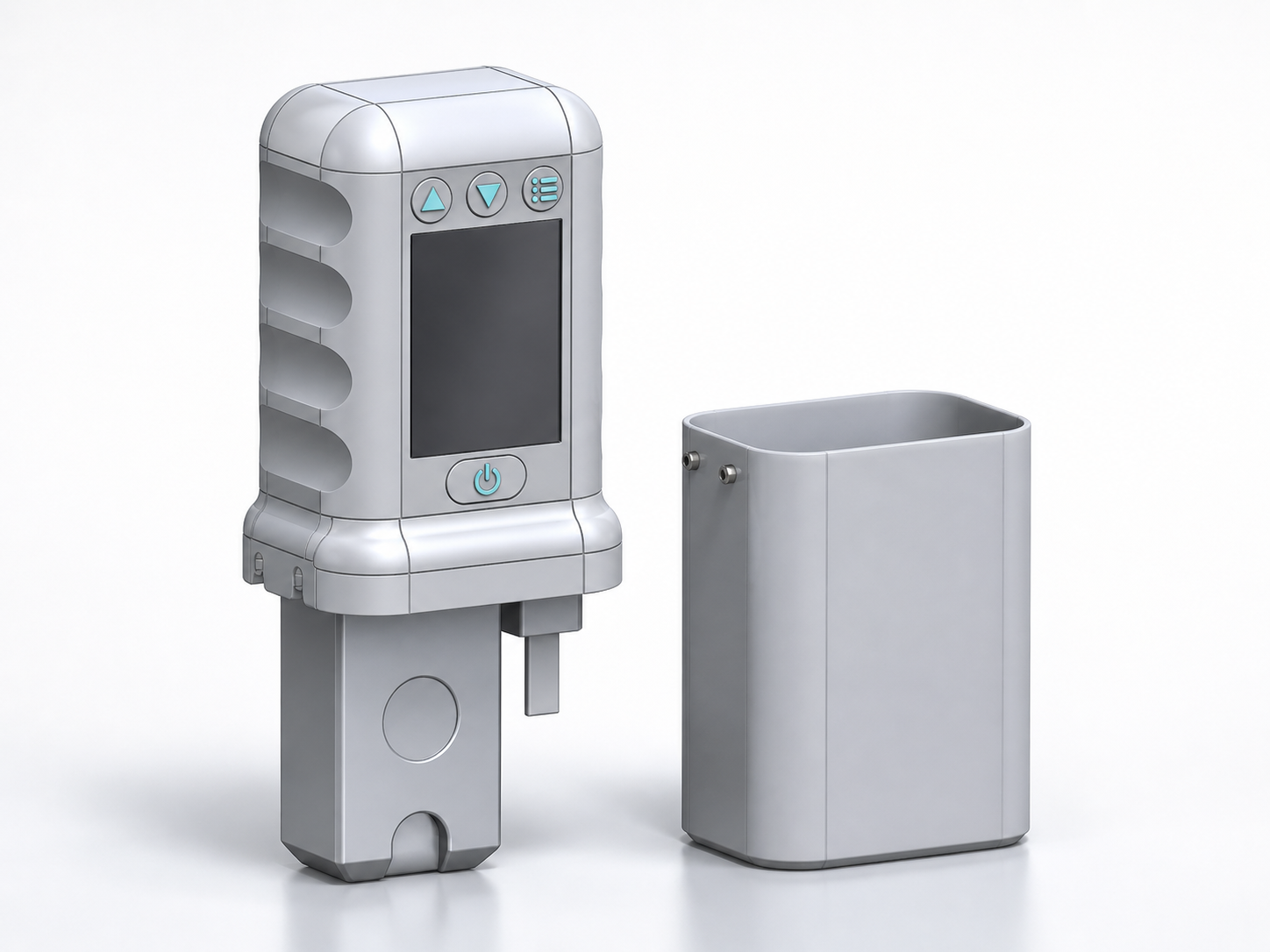
The Osmurix approach
Osmurix combines a portable reader with a proprietary disposable cup to complement the standard diary with objective urine osmolality measurements across the day and night.
Design targets, not measured product performance. Internal comparison against one representative commercial freezing-point osmometer; not independently verified.
Value across the care pathway
Osmurix is being designed around the people who interpret, deliver and live with nocturia care—not only the instrument on the bench.
Add an objective water-versus-solute signal as supplemental information alongside the bladder diary, for the clinician to interpret.
Decision clarityDesigned to fit existing outpatient workflows, with collection and measurement carried out at home rather than through a central laboratory.
Workflow-friendlyBuild a three-day physiological profile at home, without repeated central-laboratory visits or cold-chain sample logistics.
Home-based profilingCommercial model in development. Pricing has not been determined and the device is not offered for sale.
Patent-pending tri-modal sensing
A proprietary combination of electrical, optical and adsorption methods is engineered to resolve the main contributors to urine osmolality in a portable format.
Measures conductive solutes, including the signal associated with sodium chloride.
Reads refractive index to quantify the remaining dissolved constituents.
Reduces large-molecule interferents so the optical signal can be interpreted more precisely.
A clinically familiar measurement, generated without freezing-point instrumentation.
Patent applications filed across Singapore, the United States, Europe, Japan and China.Exclusive licensing from the originating research institutions is in progress
Analytical and early clinical evidence
The underlying method has been tested across a broad sample set, while the integrated handheld prototype is now being evaluated in an ongoing clinical study at a Singapore public hospital.
These early integrated-device results are encouraging but are based on a small initial sample. The study is expanding the analytical-accuracy dataset required for product development and regulatory submission.
Watch and understand
Begin with the burden of the midnight wake-up call, then see how urine osmolality adds the missing physiological dimension.
Collaborate with Osmurix
We welcome conversations with clinical sites, research collaborators, strategic partners and investors.